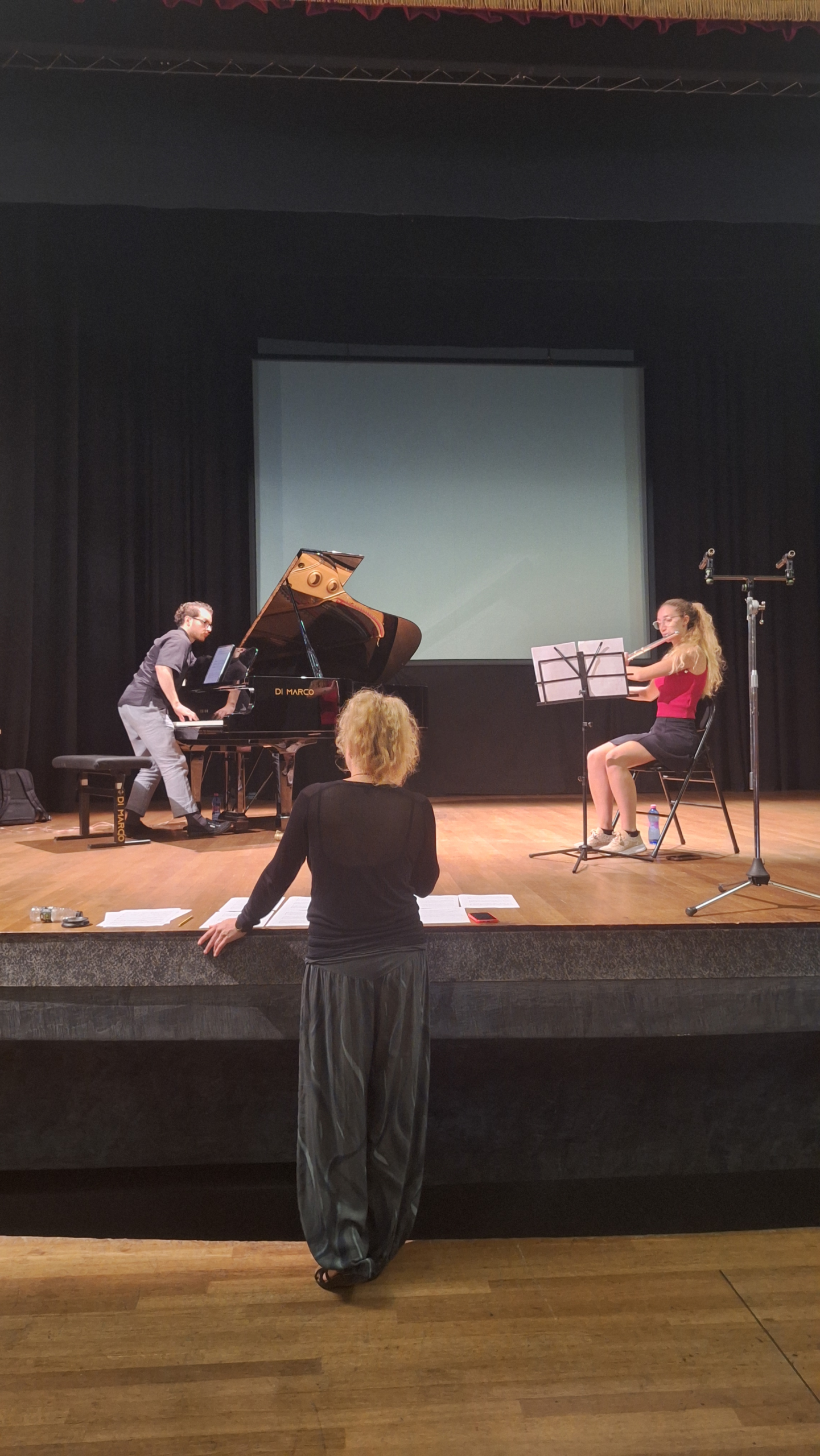
Ómur is a composition for flute, piano, and fixed media that explores sound as a site of resonance, friction, and co-presence. The title, meaning “echo” or “resonance” in Icelandic, reflects the work’s attention to what persists, including breath, decay, tactile gesture, and sonic afterimage. The musical materials are shaped through focused decisions around duration, density, and spatial proximity, with equal emphasis on what is played and what is withheld.
The fixed media is conceived as an acousmatic layer that integrates with the acoustic instruments through transducers placed directly on the piano soundboard. This setup allows the electronics to resonate within the body of the piano, extending its material presence and reinforcing a shared acoustic field. Each sample is designed to hold its place within the structure, in conversation with instrumental gesture and silence.
The composition develops from a process of compositional seeding, where musical ideas are derived from speech and textual analysis. These seeds are transformed into gestural, rhythmic, and harmonic material, articulated across both instrumental and electronic layers. The form emerges through the shaping of tension, breath, and alignment. It creates conditions for a listening experience grounded in physical gesture and temporal precision.
Material is treated with restraint, not as minimal, but as deliberately bounded. It is shaped through processes of distillation, spacing, and pressure. The score creates conditions for attentive interaction between performers and systems. It allows interpretation while maintaining structural clarity. Across its sections, Ómur reflects an evolving compositional practice concerned with proximity, resonance, and the construction of shared sonic environments.
Composed in 2025
between London, Reykjavík, and San Marino
Premiered on 8 August 2025
at Teatro Concordia di Borgo Maggiore, San Marino
as part of MUSICARTE Contemporanea
San Marino International Music Courses (SMNMP’25)
Performed by
Letizia Caspani (flute)
Michelangelo D’Adamo (piano)
© 2025 Anna Troisi
All rights reserved